MAT Impact: From Inconsistency to Impact
How WPAT built a connected, scalable approach to literacy - and improved outcomes for children.
The challenge: consistency at scale
When WPAT began its improvement journey, literacy provision varied significantly between schools. Some approaches were working well, but success could depend too heavily on individual teachers or leaders.
As the trust grew, that created a challenge: how could high-quality literacy teaching become consistent and scalable without removing the individuality of each school?
Louise Smith, CEO of WPAT, describes the trust's approach as “aligned autonomy”: schools retain their identity, while the expected standard of teaching and learning is shared. Literacy Counts became part of the solution because it combined high-quality curriculum content with training and a structured approach that could be implemented across a growing Trust.
A sustained improvement journey - not a quick fix
WPAT's relationship with Literacy Counts has developed over several years. Its schools now use the connected Literacy Counts resources across reading, writing, spelling and handwriting, alongside participation in the Everybody Write school-improvement project.
Louise is particularly clear that the impact has been built steadily rather than through a short-term spike in results. Trust performance in both combined reading, writing and mathematics and in writing has risen year on year since the adoption of Literacy Counts resources. She attributes that sustained improvement to repeated professional development, consistent implementation and the deliberate strengthening of staff knowledge over time.
That matters for a Trust because sustainable improvement cannot depend on a handful of exceptional individuals. Teachers move schools, retire or change roles. A coherent curriculum, supported by strong professional learning, helps ensure that expertise is embedded in the organisation rather than disappearing when an individual leaves.
The data: a Trust moving forward
The emerging 2026 picture is particularly encouraging.
At the time of our conversation, WPAT's provisional combined Reading, Writing and Mathematics figure across its schools was approximately 74%*. This is above the national.
*Louise stressed that this was raw, provisional data and that final figures were still subject to remarks and adjustments.
The longer-term trend is equally important.
Louise reports that WPAT's performance has improved year on year and that the MAT was ranked 33rd nationally within its academy comparison group in the previous year. Its performance improved again in 2026.
The Trust serves very different communities, with levels of disadvantage ranging from very low in some schools to around 80% in others. Yet the pattern of improvement is not confined to more advantaged settings.
One of the most striking indicators is the performance of disadvantaged pupils.
Louise reports that the gap between pupil-premium and non-pupil-premium pupils across WPAT had reduced to approximately 6%. She contrasted this with a much wider national gap and described WPAT's position as ‘phenomenal’.
Closing the disadvantage gap
The 2026 data gives WPAT a clearer, measure-by-measure picture of outcomes for disadvantaged pupils.
At the end of EYFS, 66.7% of pupils eligible for free school meals achieved a Good Level of Development, compared with 75.5% of non-FSM pupils.
In the Year 1 Phonics Screening Check, 72.4% of disadvantaged pupils met the expected standard, compared with 89.8% of non-disadvantaged pupils.
At the end of Year 6, 72.9% of disadvantaged pupils achieved the expected standard in reading and 68.7% in writing.
Louise is careful not to reduce vulnerability to a single label.
Some children experience several overlapping barriers - SEND, disadvantage, care experience or wider social challenges. For these pupils, consistency, adaptive teaching and predictable classroom routines are especially important.
She believes the number of pupils remaining in the lowest-attaining group has reduced year on year. Further national progress data is expected later in 2026, which WPAT hopes will provide additional evidence of the progress made by pupils from their individual starting points.
Two schools that show what improvement can look like
The trust-wide picture becomes even more powerful when viewed through individual schools.
At one highly disadvantaged school, Frodsham Primary Academy, Louise describes a journey from Special Measures to a Good Ofsted judgement, with some outstanding features, within approximately three years. Writing and spelling performance are now described by the trust as well above national levels.
At Kingsway Primary Academy, another school serving a community with very high levels of disadvantage and complex need, Louise says writing outcomes have “quadrupled” over the last three to four years. Staff retention can be challenging in such a context, making sustainable planning, training and curriculum structure particularly important.
What the impact looks like beyond the headline data
For Louise, attainment data is only one layer of evidence.
If another MAT CEO visited WPAT, she says she would show three things:
the trust's trend data
children's writing books, including those of disadvantaged pupils and pupils with SEND or multiple barriers
the lived experience of teaching in classrooms.
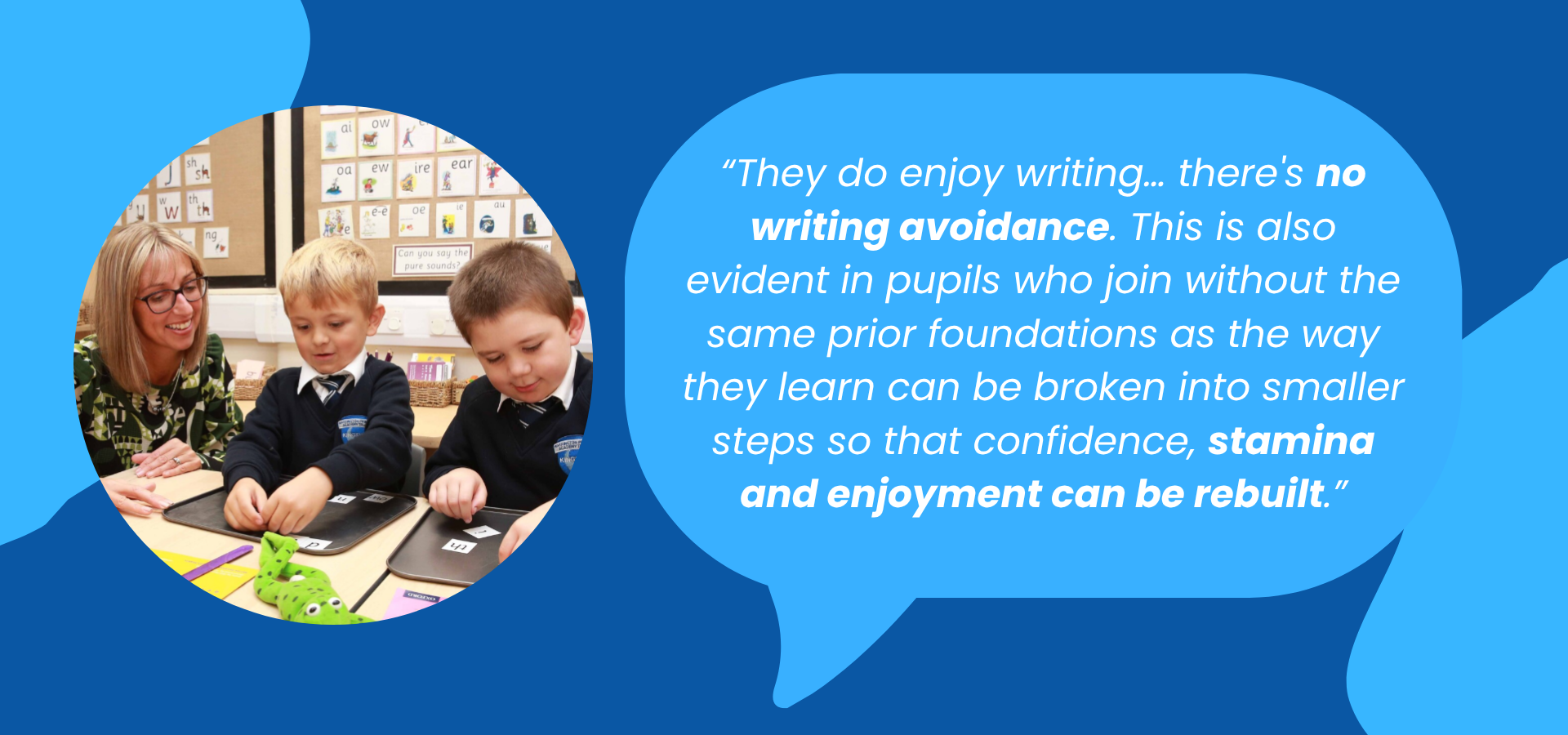
She describes children developing greater writing stamina because skills taught explicitly in English are then applied in history, geography, science and other curriculum areas. Familiar structures help pupils understand what is expected, apply prior learning and take greater risks as writers.
Why connectivity matters
WPAT's schools use Literacy Counts across reading, writing, spelling and handwriting. For Louise, the value is not simply having several resources from one provider; it is that the components make sense together.
She describes the approach as an “architectural structure” within which the different elements are held. Teachers can move naturally between them, while pupils recognise familiar routines and connections in their learning.
“It's not a new bolt-on gimmick, it naturally makes those links.” She describes the connections between the different elements as “golden threads” - clear to teachers and increasingly clear to children too.
That connectedness supports the principle at the heart of WPAT's model: consistency does not mean every school or every classroom must look identical. Instead, it provides a secure structure within which teachers can adapt, respond and retain their school's individuality.
A different kind of assurance for trust leaders
One of the most revealing impacts sits at trust leadership level. Louise says a high-quality, standardised curriculum gives WPAT greater assurance about what is being taught and the professional development staff have received.
When performance dips in one school or year group, leaders can therefore investigate more precisely. Rather than beginning by questioning the curriculum or planning, they can examine implementation, leadership, staffing, behaviour, capacity or other contextual factors. Louise says this helps WPAT identify problems and respond within days.
Common curriculum structures also strengthen moderation and standardisation. Teachers in the same year group can compare work across schools, experienced colleagues can support less experienced staff and leaders can identify patterns before they reach Year 6.
For a MAT of almost 500 staff, that shared framework creates both quality assurance and professional connection: in Louise's words, “We are one; we just operate on different sites.”
Expert support when schools need it
The relationship extends beyond access to resources. Louise describes the ability to bring in a Literacy Counts specialist quickly when a school needs additional support as “absolutely fabulous”.
Because consultants already know the programmes and have established relationships with staff, intervention can happen rapidly and supportively. Louise says that after identifying an issue, expert help can be in place within days, without losing valuable time.
She also highlights the calibre of the consultancy team. Even WPAT's most experienced teachers continue to learn from Literacy Counts specialists because consultants work across many schools and bring current insight back into professional development.
The child is the evidence
Perhaps Louise's strongest reflection is also the simplest. Asked what she would show another MAT CEO to demonstrate impact, she returns to the children.
Yes, she would begin with trend data. But she would then open children's books, visit classrooms, watch an early-career teacher confidently deliver high-quality learning and talk directly to pupils about their writing.
She would want another MAT leader to see children, including those facing significant barriers, talking enthusiastically about books, explaining their writing and showing the confidence to say: “I can do this.”
For WPAT, that is where systems, curriculum, professional development and partnership ultimately meet. Leaders create the conditions; teachers bring the curriculum to life; and the evidence is visible in what children know, what they produce and how they feel about themselves as writers.
As Louise puts it: “We can see the outcomes... we can see how well the children are thriving. And I think the big seller is: look at them enjoying their writing.”
2026 outcomes: Impact across the literacy journey
WPAT's 2026 outcomes add a powerful new layer to the story. They show attainment at key points across the primary literacy journey - from the end of EYFS, through the Year 1 Phonics Screening Check, to reading and writing at the end of Year 6.
EYFS - Good Level of Development: 73.0% all pupils | 66.7% FSM | 75.5% non-FSM | 8.9 percentage-point gap
Year 1 Phonics Screening Check: 84.0% all pupils | 72.4% disadvantaged | 89.8% non-disadvantaged | 17.4 percentage-point gap
Year 6 Reading: 80.2% all pupils | 72.9% disadvantaged | 86.2% non-disadvantaged | 13.3 percentage-point gap
Year 6 Writing: 78.6% all pupils | 68.7% disadvantaged | 86.7% non-disadvantaged | 18.0 percentage-point gap
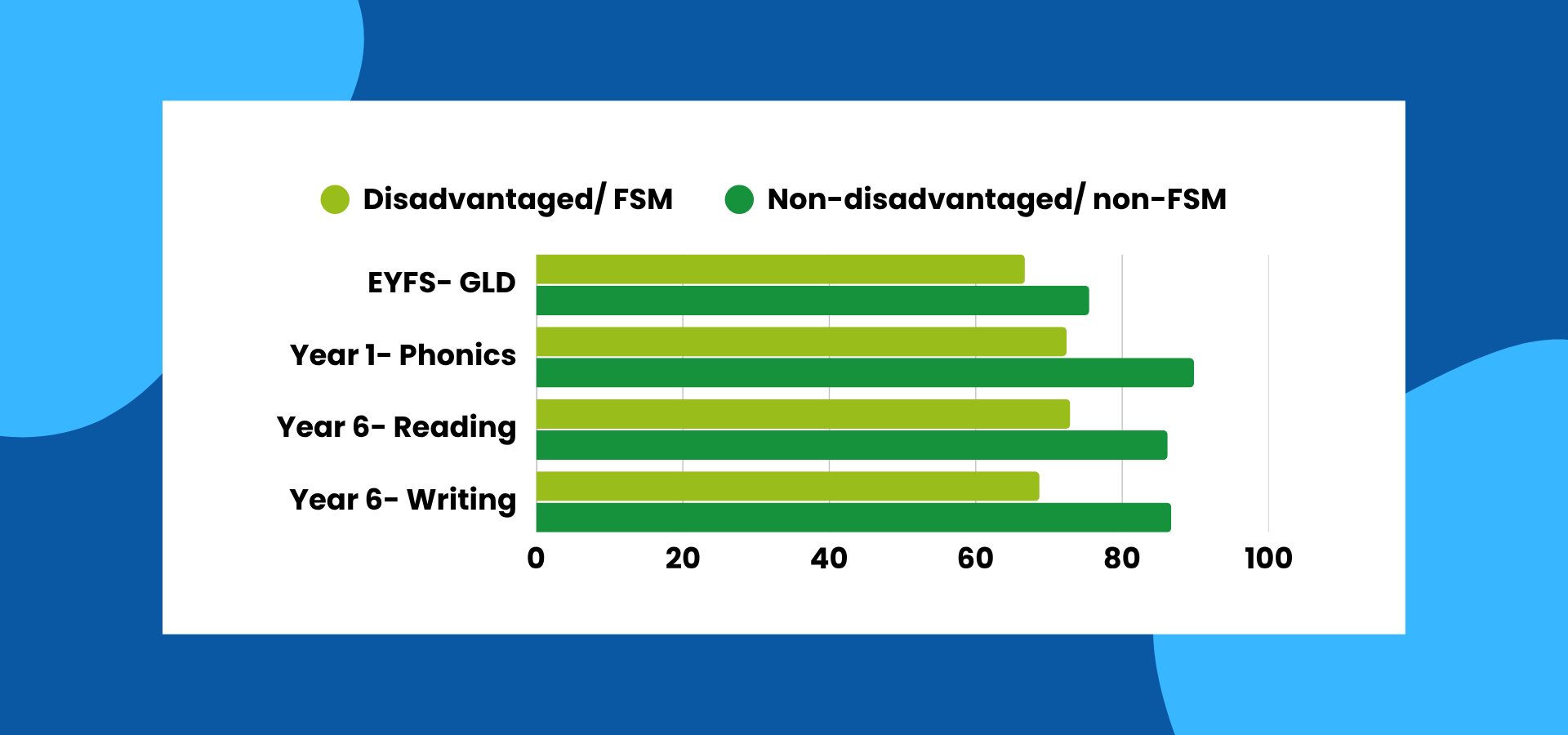
The headline outcomes are striking: 84.0% of all pupils met the expected standard in the Year 1 Phonics Screening Check; by the end of Year 6, 80.2% achieved the expected standard in reading and 78.6% in writing. For a Trust serving communities with levels of disadvantage ranging from very low to around 80%, the data provides a powerful picture of attainment across very different contexts.
WPAT is equally clear-eyed about the gaps that remain. Rather than treating strong overall attainment as the end point, leaders use the measure-level data to identify where disadvantaged pupils face greater barriers and where further improvement is needed. That combination of strong outcomes, transparency and precise diagnosis reflects the Trust's wider approach: celebrate what is working, identify inconsistency early and respond quickly.
Taken alongside WPAT's year-on-year improvement, children's books, classroom evidence and Louise's account of greater writing stamina, confidence and enjoyment, the 2026 figures make the impact visible across the literacy journey - from early development and phonics to reading and writing at the end of primary school.
A partnership built for sustainable impact
WPAT chose Literacy Counts because it wanted consistency, scalability and an approach that would survive changes in staffing and leadership. It recommends the partnership because it can now see the impact of those decisions in professional practice, school improvement and children's outcomes.
The story is not that a resource alone transformed nine schools. School improvement is more complex than that, and the leadership, teachers and children of WPAT own their achievements.
The significance of the partnership is that Literacy Counts has helped provide a coherent curriculum, sustained professional development and specialist support within which that improvement can grow. For a Trust, that is the difference between buying resources and building capacity.
And for the children, it means something even more important: greater consistency, stronger teaching, rising outcomes and the confidence to see themselves as successful readers and writers.
Thank you!
We would like to thank Louise Smith, CEO of WPAT, for kindly sharing her experiences. It has been a privilege to hear about the impact Ready Steady Literacy is having on Warrington Primary Academy Trust.
Find out more
Are you a Multi-academy trust looking for a similar impact?
Book a free discovery call with one of our expert consultants today and see how Literacy Counts can support your school.