The Education Endowment Foundation has introduced an important new way of looking at educational programmes. Rather than asking only whether a programme works as a complete package, its new Core Components Project asks a more searching question:
What are the individual practices within a programme that might help explain how and why it works?
The EEF describes these core components as the observable elements or “active ingredients” within a programme. Its new Teaching and Learning Taxonomy identifies 78 components organised across 12 dimensions, creating a shared language for examining what actually happens within educational programmes.
For schools, clusters and Multi-Academy Trusts, this is an important development.
When leaders invest in a programme, they should be able to look beyond attractive resources or a sequence of lessons. They need to understand the pedagogical approaches, assessment, professional development, implementation support and leadership structures that sit behind those resources.
That is why the EEF’s new framework is particularly interesting to us at Literacy Counts.
When we look at the 12 dimensions through the lens of our Ready Steady Literacy programmes, we see many of the principles that have shaped their development: responsive teaching, formative assessment, cognitive science, communication and oracy, metacognition, engagement, professional development and, crucially, implementation.
What the taxonomy provides is a useful new lens through which leaders can scrutinise the architecture of a programme. And when we apply that lens to Ready Steady Literacy, there is a great deal to see*.
1. Adaptive or responsive approaches: keeping ambition high while responding to need
Effective curriculum provision cannot mean giving every child exactly the same support. Across Ready Steady Literacy, adaptation is built around maintaining ambitious curriculum expectations while changing the support children receive to reach them.
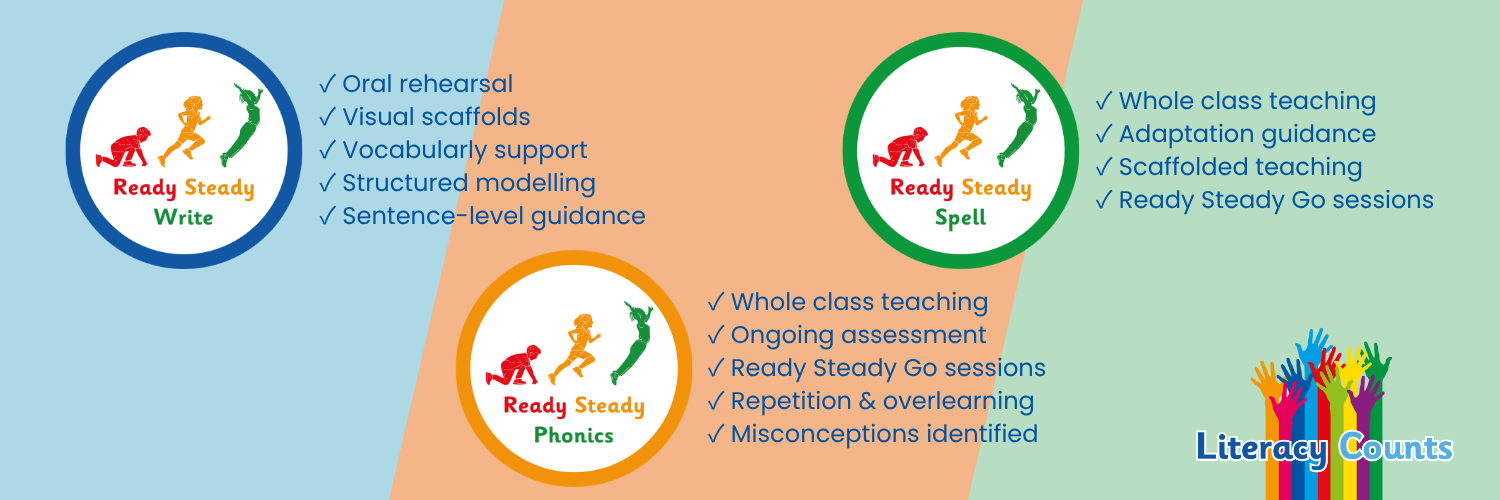
In Ready Steady Write, for example, children encounter oral rehearsal, visual scaffolds, vocabulary support, structured modelling, sentence-level guidance and gradual release towards independence. The programme also provides support for mixed-age teaching and enables teachers to draw on prior-year sentence content where this meets children’s needs.
Ready Steady Phonics combines whole-class teaching with ongoing assessment and targeted Ready Steady Go sessions when children require additional consolidation. The programme uses structured repetition and overlearning, with misconceptions identified through formative assessment so support can respond quickly to need.
Ready Steady Spell similarly combines whole-class provision with adaptation guidance, scaffolded teaching and Ready Steady Spell: Go for children requiring additional support.
The principle is consistent: adapt the route, not the ambition.
2. Formative assessment approaches: making learning visible
Assessment is most powerful when it changes what happens next. That principle runs throughout the Ready Steady Literacy suite.
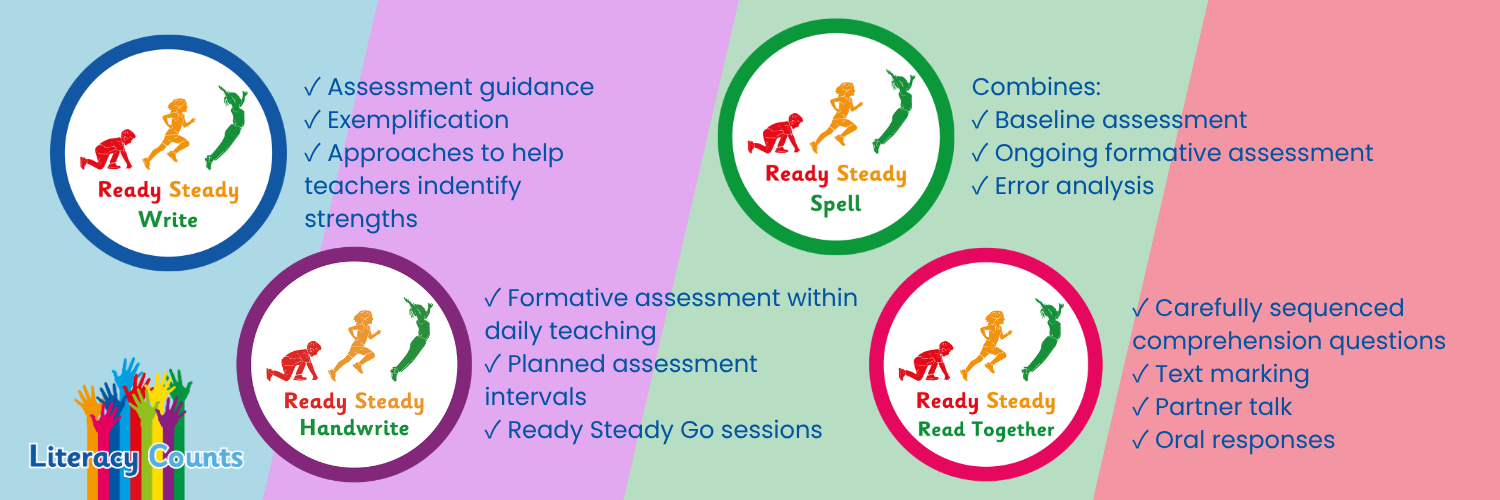
Ready Steady Handwrite embeds formative assessment within daily teaching, alongside planned assessment intervals. Teachers can identify misconceptions and use this information to determine who needs additional Ready Steady Go teaching and precisely what that teaching should address.
Ready Steady Read Together combines carefully sequenced comprehension questions, text marking, partner talk, oral responses and written work so that teachers can see children’s thinking as it develops. This allows misconceptions and next steps to emerge during learning rather than only after it.
Ready Steady Spell combines baseline assessment, ongoing formative assessment and error analysis so teachers can identify gaps, revisit learning and target support.
Ready Steady Write provides assessment guidance, exemplification and approaches that help teachers and leaders identify strengths and areas for development and use that knowledge to inform subsequent teaching.
Across the suite, assessment is not simply something that happens after teaching. It is part of teaching.
3. Cognitive approaches: designing learning that can be remembered and applied
Learning places significant demands on working memory. If we want children to become fluent readers, writers and spellers, important knowledge and processes need to become increasingly secure and automatic. That thinking can be seen across Ready Steady Literacy.
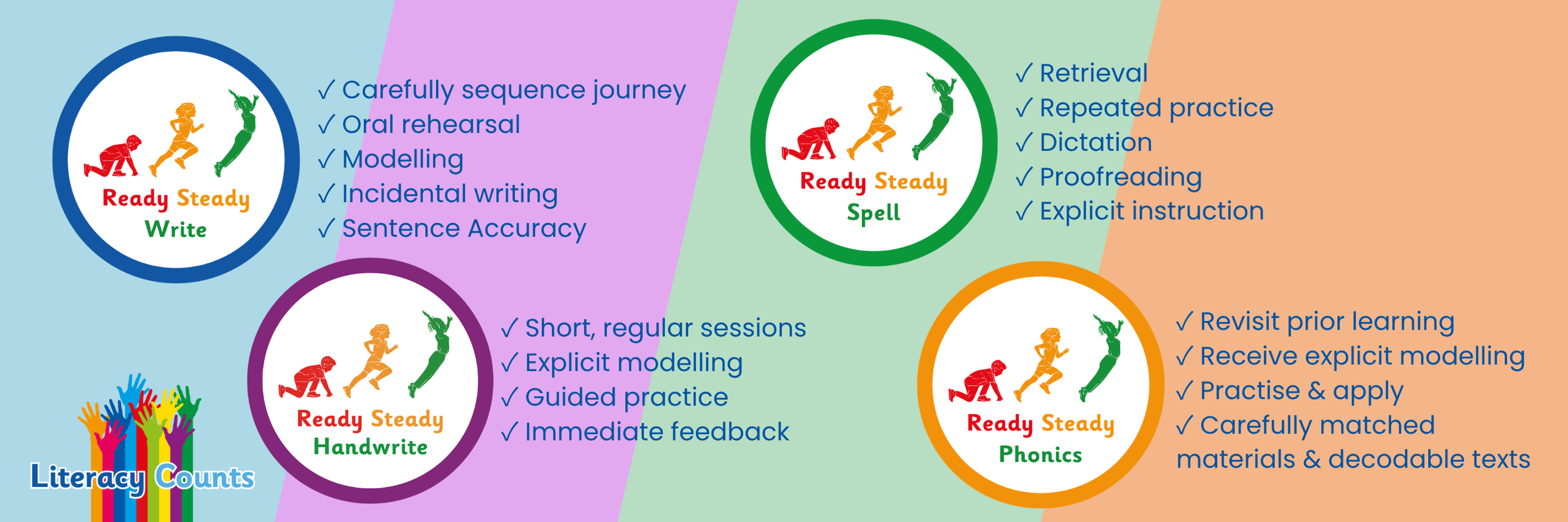
Ready Steady Spell uses retrieval, repeated practice, dictation, proofreading, explicit instruction and a cyclical model that introduces, reinforces and embeds learning over time. Its strategies and Memory Lock activities help children retrieve and apply spelling knowledge rather than relying on isolated weekly memorisation.
Ready Steady Phonics is deliberately cumulative. Children revisit prior learning, receive explicit modelling, practise and then apply their developing phonic knowledge through carefully matched materials and decodable texts.
Ready Steady Handwrite addresses cognitive load from another direction: by developing increasing automaticity in transcription. Short, regular sessions combine preparation, explicit modelling, guided practice and immediate feedback so that letter formation and, later, joining become increasingly fluent.
And Ready Steady Write breaks the complex act of writing into a carefully sequenced journey of Immerse, Analyse, Plan and Write, supported by oral rehearsal, modelling, incidental writing and Sentence Accuracy.
The aim is not to make learning simplistic. It is to manage complexity intelligently so children can eventually handle more of it independently.
4. Communication approaches: talk, vocabulary, reading and writing working together
Literacy is fundamentally about communication. That makes this one of the clearest dimensions across the Ready Steady Literacy suite.
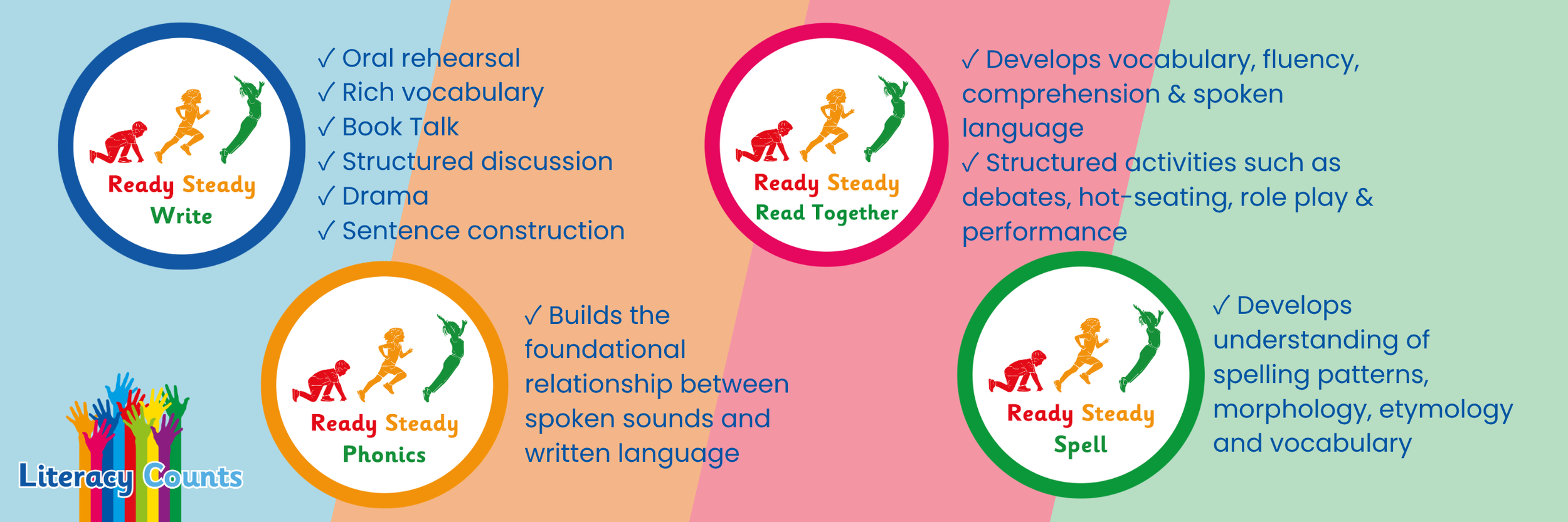
Ready Steady Write places oral rehearsal, rich vocabulary, Book Talk, structured discussion, drama and sentence construction at the heart of the writing process. Children develop and refine ideas through talk before committing them to writing.
Ready Steady Read Together explicitly develops vocabulary, fluency, comprehension and spoken language. Children discuss texts with partners, justify ideas using evidence and participate in structured activities such as debates, hot-seating, role play and performance.
Ready Steady Phonics builds the foundational relationship between spoken sounds and written language, while Ready Steady Spell develops understanding of spelling patterns, morphology, etymology and vocabulary.
Rather than treating speaking, reading, spelling and writing as disconnected curriculum strands, the suite deliberately creates connections between them.
5. Family engagement approaches: extending literacy beyond the classroom
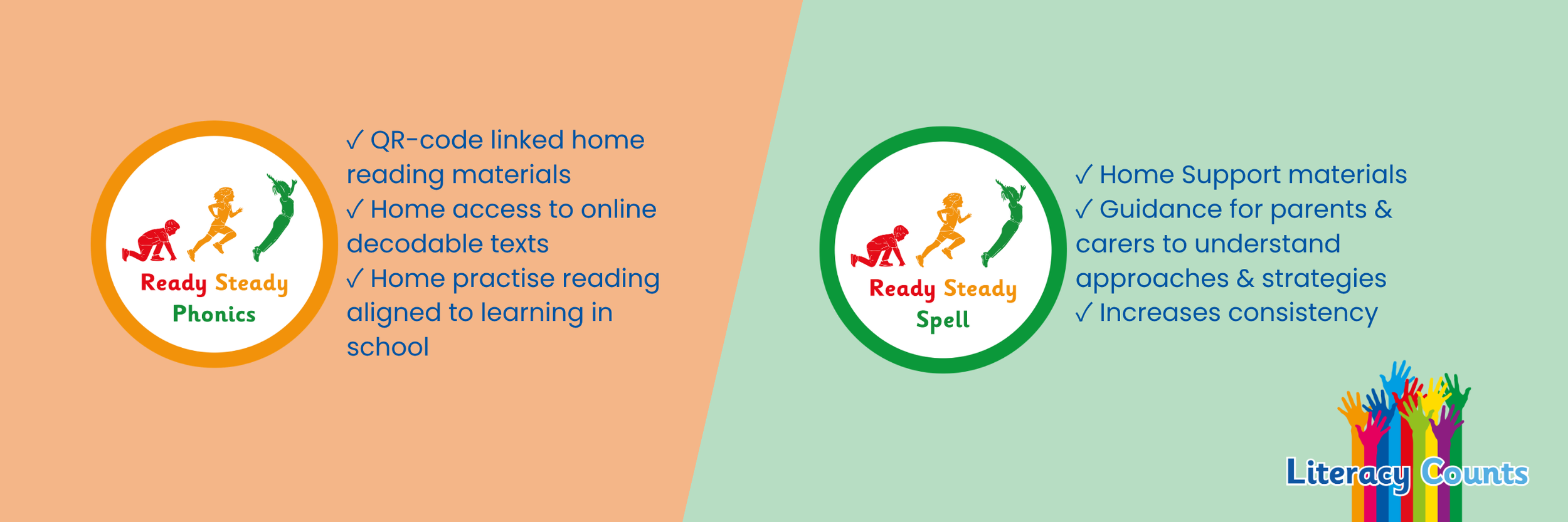
Schools have children for only part of their day. Helping families understand and reinforce learning can therefore make an important contribution to consistency. Ready Steady Phonics includes QR-linked home reading materials and access to decodable texts so that children can practise reading at home using material aligned with what they have learned in school.
Ready Steady Spell includes Home Support materials designed to help parents and carers understand the approaches and strategies children encounter in school, creating greater consistency between classroom learning and home practice.
The objective is not to turn parents into teachers. It is to give families clear, accessible ways to reinforce the learning children already understand.
6. Metacognitive approaches: helping children understand how they learn
Successful learners increasingly need to know not only what to do, but how to approach a task.
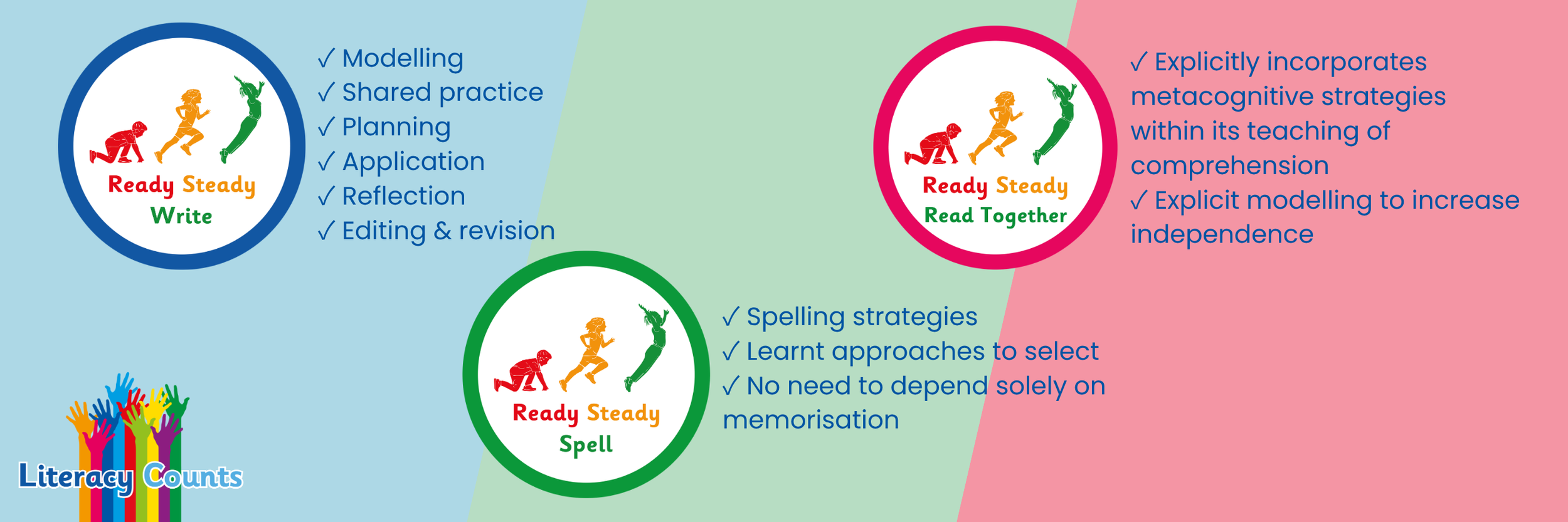
Ready Steady Read Together explicitly incorporates metacognitive strategies within its teaching of comprehension. Teachers model how skilled readers approach texts before children practise and apply those approaches with increasing independence.
Ready Steady Spell makes this especially visible through its spelling strategies. Children learn approaches they can select, use and reflect upon when tackling words rather than depending solely on memorisation.
Ready Steady Write similarly moves pupils through modelling, shared practice, planning, application, reflection, editing and revision.
Across the programmes, the direction of travel is consistent: from teacher expertise towards increasingly independent learners.
7. Approaches to motivate and engage: giving children reasons to participate
Engagement should not be an optional extra added after curriculum design. The curriculum itself should invite children into learning.
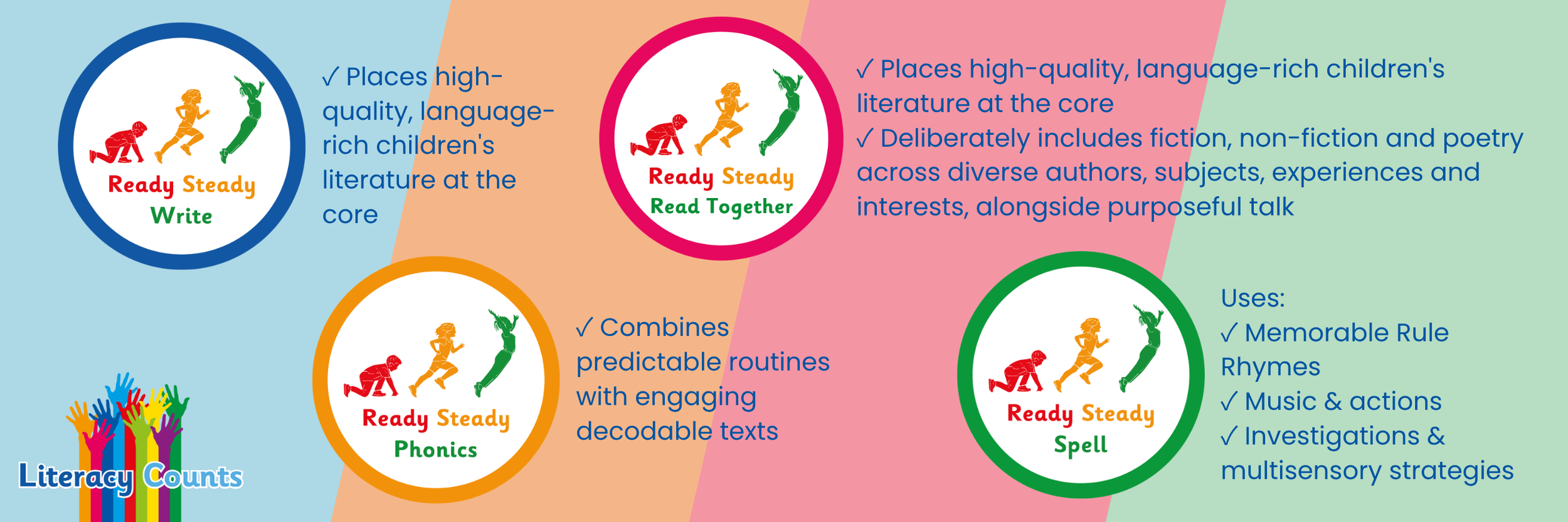
Ready Steady Write and Ready Steady Read Together place high-quality, language-rich children's literature at their core.
Ready Steady Read Together deliberately includes fiction, non-fiction and poetry across diverse authors, subjects, experiences and interests, alongside purposeful talk, rereading and opportunities to read for both knowledge and pleasure.
Ready Steady Spell uses memorable Rule Rhymes, music, actions, investigations and multisensory strategies to make abstract spelling knowledge easier to access and remember.
Ready Steady Phonics combines predictable routines with engaging decodable texts, visuals and opportunities for successful application.
This matters because confidence and engagement are closely connected. When children understand the task, have the tools to succeed and can see themselves making progress, participation changes.
8. Physical approaches to learning: developing the physical foundations of literacy
This dimension becomes particularly visible through transcription.
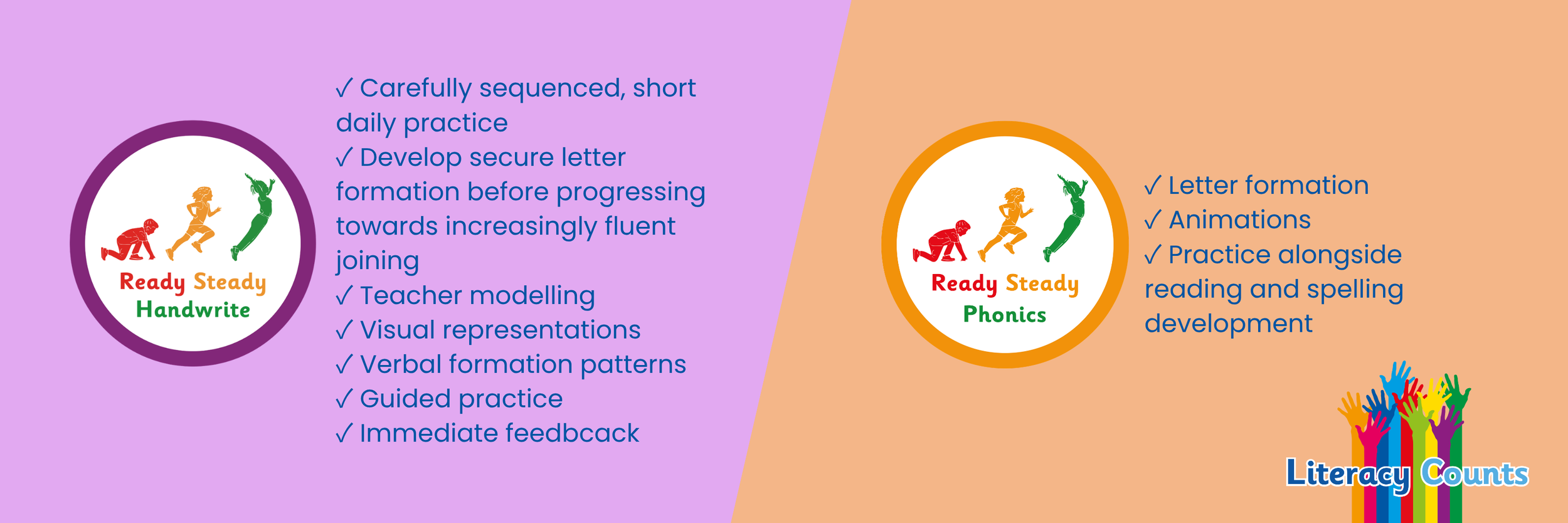
Ready Steady Handwrite explicitly teaches the physical act of handwriting through carefully sequenced, short daily practice, beginning in Reception. Children develop secure letter formation before progressing towards increasingly fluent joining, with teacher modelling, visual representations, verbal formation patterns, guided practice and immediate feedback.
Ready Steady Phonics also incorporates letter formation, animations and practice alongside reading and spelling development.
These elements recognise an important truth about writing: cognition and physical fluency are connected. When transcription becomes increasingly automatic, children can devote more of their attention to spelling, vocabulary, sentence construction and composition.
9. Social and emotional approaches: building confidence, independence and successful participation
Ready Steady Literacy is first and foremost a literacy suite rather than a standalone social and emotional learning programme. However, several design features create conditions that support confidence, collaboration and successful participation.
Structured partner talk, shared discussion, oral rehearsal and collaborative interpretation create supported opportunities for children to contribute ideas. Scaffolding and gradual release help children experience success before moving towards independence.
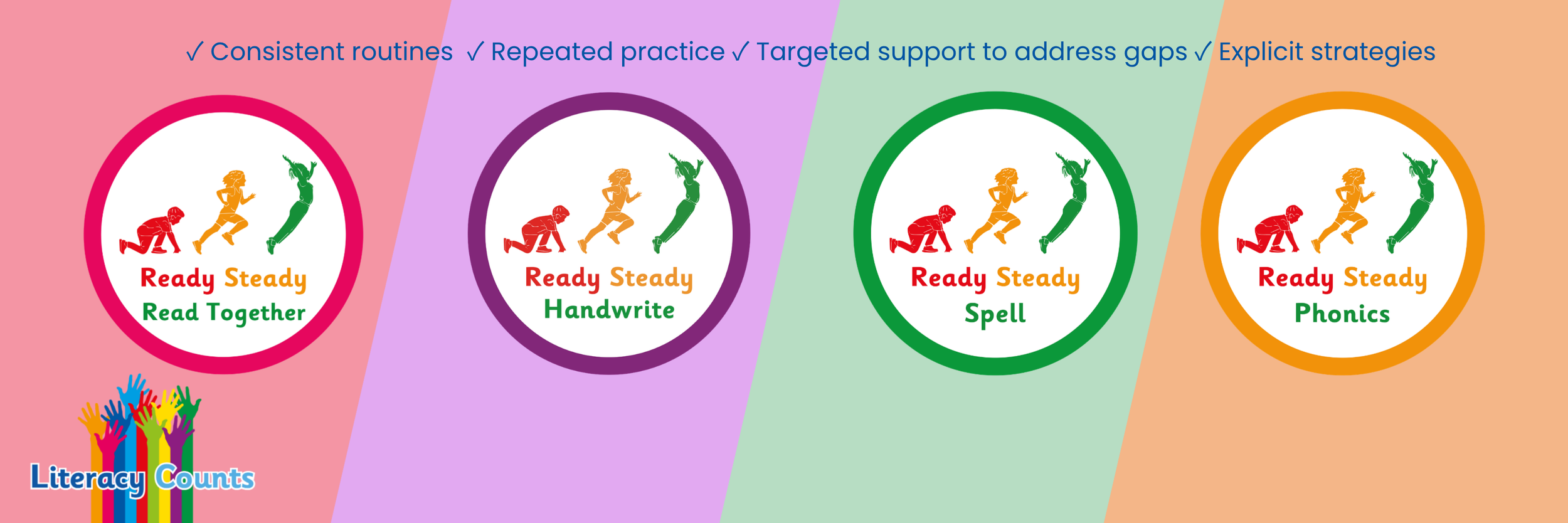
In spelling, handwriting, reading and phonics, consistent routines, repeated practice and targeted support aim to address gaps before repeated difficulty becomes a barrier to participation.
Across the suite, children are not expected simply to “have a go” without the knowledge or support they need. They are explicitly taught strategies that help them become increasingly confident and independent.
10. Structural approaches: organising teaching and additional support around learning needs
Structure matters because even strong pedagogy can lose impact if schools cannot organise it effectively.
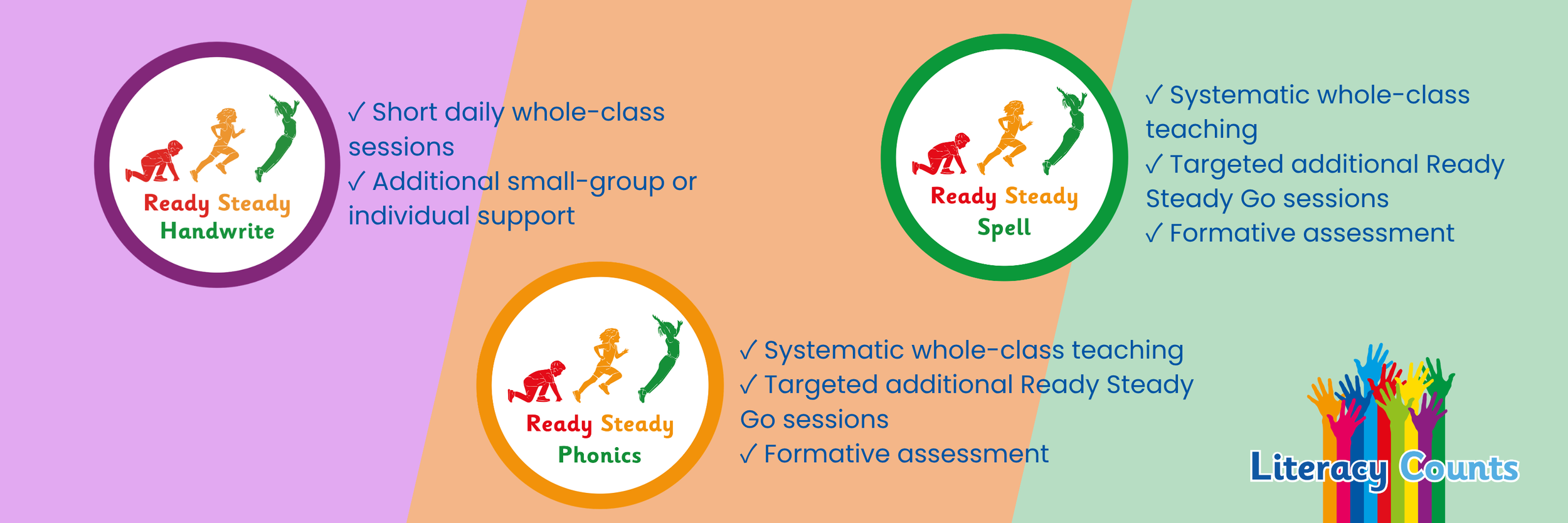
Ready Steady Phonics combines systematic whole-class teaching with targeted additional Ready Steady Go sessions for children requiring further support. Formative assessment helps determine who needs that support and what should be taught.
Ready Steady Spell follows a similar principle through whole-class provision alongside Ready Steady Spell: Go.
Ready Steady Handwrite can be taught efficiently through short daily whole-class sessions, with additional small-group or individual support where children need further consolidation.
This gives schools a coherent core entitlement while creating structured mechanisms for responding when some pupils need more.
11. Professional development approaches: developing teachers, not just supplying resources
This dimension is critical. A programme cannot be stronger than the knowledge and practice of the adults implementing it. That is why Ready Steady Literacy does not stop at providing resources.
Ready Steady Phonics, for example, includes training and professional support designed to develop understanding of phonics pedagogy, lesson structure, assessment and effective modelling. Planning, resources, coaching and continued professional development then support implementation beyond initial training.
Ready Steady Write develops subject knowledge through detailed planning, modelling, shared writing, vocabulary instruction, grammar guidance, assessment exemplification, progression documents and video exemplification.
Across the wider Ready Steady Literacy offer, professional development, consultancy and leadership support help teachers understand not simply what to deliver, but the pedagogical thinking behind it.
For MATs and clusters, that becomes particularly powerful. A shared programme can create common language and expectations, but professional development helps create the shared expertise required to bring that programme to life.
12. Approaches to support implementation: turning a programme into sustained practice
Perhaps one of the most significant features of the EEF's taxonomy is that implementation sits alongside classroom pedagogy. That matters. Schools do not improve simply because they purchase good resources. They improve when leaders create the conditions in which strong practice can become embedded, monitored, refined and sustained. This is why leadership days, implementation guidance, training, progression documentation, assessment systems, ongoing professional development and implementation support are such important parts of the Ready Steady Literacy model.
Ready Steady Spell, for example, begins implementation with leadership and staff training, including a leadership day designed to establish action planning, documentation and systems before whole-staff implementation.
Ready Steady Phonics combines teaching materials and assessment with training, leadership consultancy and adaptive teaching support designed to create sustainable whole-school implementation.
Literacy Counts also provides ongoing implementation support sessions in which leaders can reflect on early implementation, explore barriers, strengthen consistency and receive further guidance. This closely reflects one of the most useful ideas within the EEF's Core Components Project: resources are only one component of an educational programme.
The bigger picture: the strength is in the combination
Perhaps the most interesting question raised by the EEF's work is not whether a programme contains one particular component. It is what happens when strong components work together. Consider a child learning to spell.
Explicit instruction matters. But so does retrieval. So does modelling. So does formative assessment. So does responding when a misconception appears. So does targeted additional teaching. So does metacognition. So does reducing unnecessary cognitive load. So does teacher subject knowledge. So does consistent implementation from one classroom to another.
Remove enough of those ingredients and the experience changes.
The same is true in writing, reading, phonics and handwriting.
This is why Ready Steady Literacy has been designed as more than a collection of resources.
Across Ready Steady Write, Ready Steady Read Together, Ready Steady Phonics, Ready Steady Spell and Ready Steady Handwrite, schools encounter carefully sequenced curriculum content alongside explicit pedagogy, modelling, scaffolding, assessment, adaptation, resources, professional development, leadership support and implementation guidance.
For a MAT or cluster, that creates another important opportunity: coherence.
Instead of individual schools or teachers independently trying to assemble different approaches to writing, reading, phonics, spelling and handwriting, leaders can establish shared principles, language and pedagogical routines while still enabling teachers to respond intelligently to their children and context.
From asking “What works?” to understanding how it works
The EEF's Core Components Project is still developing. More than 180 EEF-evaluated programmes have already been tagged according to the components they contain, and the EEF intends to investigate which individual components and combinations appear associated with stronger pupil outcomes.
That makes this an exciting direction for education. It also reinforces something we believe strongly at Literacy Counts. When schools choose a literacy programme, they should look beneath the surface. Look at the curriculum. Look at the pedagogy. Look at how knowledge is sequenced and revisited. Look at assessment and how teachers respond to it. Look at how children who need additional support are identified and supported. Look at how independence and metacognition are developed. Look at the resources teachers receive. Look at the professional development behind those resources. Look at what leaders are given to support implementation. And look at whether all those elements work coherently together.
Because the real question is no longer simply, “What resources do we get?” It is: “What are the active ingredients, how do they work together, and what will help us implement them well?” That is the question the EEF's new work encourages the sector to explore. And it is exactly the kind of question schools, clusters and MATs should be asking when they choose their approach to literacy.
*Importantly, we are not claiming that the EEF has evaluated or endorsed Ready Steady Literacy against this taxonomy. Nor does alignment with a dimension, by itself, prove effectiveness. The EEF makes this distinction clear: the taxonomy does not yet tell us which individual components are effective. Instead, it provides the infrastructure through which researchers can begin examining which components, and which combinations of components, appear most promising.