Reading for Pleasure: Text Selection and Curriculum Connections in Ready Steady Read Together
This blog is written by Melissa Buzzard, Writer at Literacy Counts. It is the second in a three-part series exploring the thinking, research and expertise behind Ready Steady Read Together.
In this instalment, Melissa focuses on reading for pleasure and the careful considerations involved in book and text selection for Ready Steady Read Together. She also explores how curriculum links are woven through fiction, non-fiction and poetry units, and how Ready Steady Read Together is deliberately designed to complement and strengthen writing outcomes through its close alignment with Ready Steady Write.
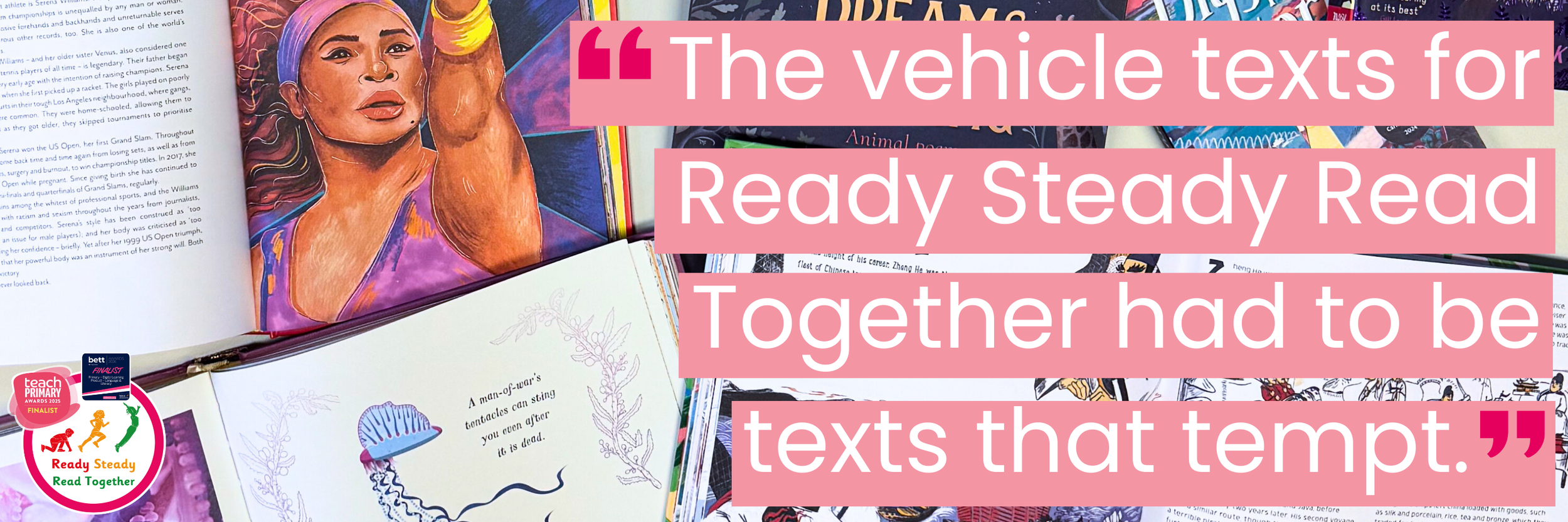
If asked what the greatest indicator of a child’s future success is, most people would think that it would be the family’s socio-economic status. In fact, reading for pleasure is the single most important indicator of a child’s future success (OECD, 2002). However, a delicate balance exists between teaching the skill of reading whilst nurturing the enjoyment of it. So, vehicle texts for Ready Steady Read Together had to be ‘texts that tempt’ (Cremin, 2024) and motivate children to want to read, furthermore the text must be visually appealing and reflect the diversity of their personal interests.
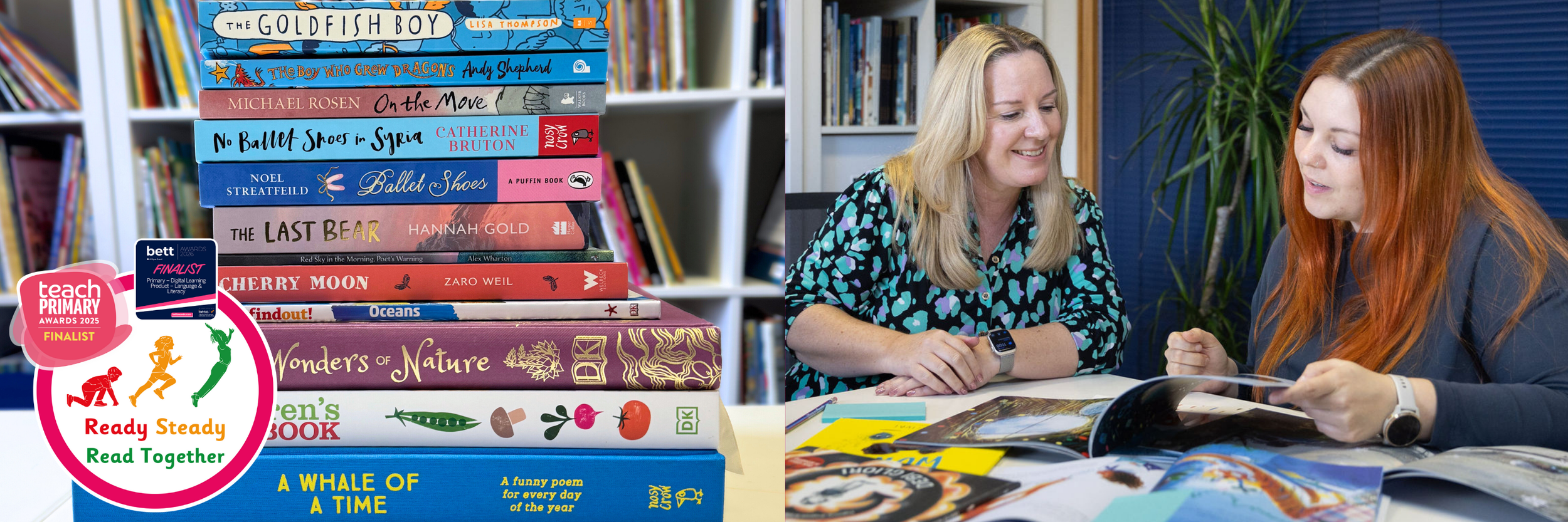
To accomplish this, a vast array of beautiful literature, including fiction, non-fiction and poetry, was carefully selected. This variety ensures that children are exposed to a wide range of genres, authors and content topics, offering something for everyone to ensure engagement whilst also introducing children to books they might not choose for themselves. Approximately 75% of our fiction texts in Key Stage Two are either award-winning, shortlisted or authored by current or past Children’s Laureates.
A Rich Range of Fiction Genres
We also sought to include an array of fiction genres including comedy (Year 2 Grimwood), mystery (Year 5 The Goldfish Boy), science fiction (Year 3 The Wild Robot), fantasy (Year 4 The Land of Roar), fairy tale (Year 3 Rumaysa), folk tale (Year 6 The House with Chicken Legs), historical fiction (Year 4 Viking Boy) and contemporary or realistic fiction (Year 4 The Last Bear).
All Ready Steady Read Together books have been specifically selected to progress in complexity across year groups. However, children also need to encounter texts with different types of complexity. Learners who can navigate these variations within texts develop into confident and successful readers.Certain books offer additional layers of complexity through features such as archaic language, non-linear time sequences, complexity of narrator or symbol or through being considered resistant texts (Lemov, 2013).
Ready Steady Read Together includes classic texts featuring archaic language across the year groups, including Year 2 Aesop’s Fables, Year 3 Charlotte’s Web, Year 4 Beowulf, Year 5 Ballet Shoes and Year 6 Grimm’s Fairy Tales.
Some books are told through a naïve, non-human or animal viewpoint, such as Year 2 Pinocchio by Pinocchio, Year 3 Harry the Poisonous Centipede, Year 3 The One and Only Ivan, Year 4 The Legend of Podkin One-Ear and Year 6 Black Beauty.
Others include multiple narrators who tell the same story from different perspectives, as in Year 5 Wonder, or share parallel stories from different time periods, as in Year 6 Refugee.
Whilst a non-linear time sequence is challenging to address through five separate extracts, several Ready Steady Read Together books include this aspect, including Year 3 Cloud Busting, Year 4 When Life Gives You Mangoes and Year 4 The Legend of Podkin One-Ear.
Our wide range of poetry exposes children to figurative, symbolic and resistant texts.
Broadening Non-Fiction Beyond the Expected
When selecting non-fiction books, we wanted to move away from the exclusive use of standard non-chronological texts and instead include a wide range of non-fiction types.
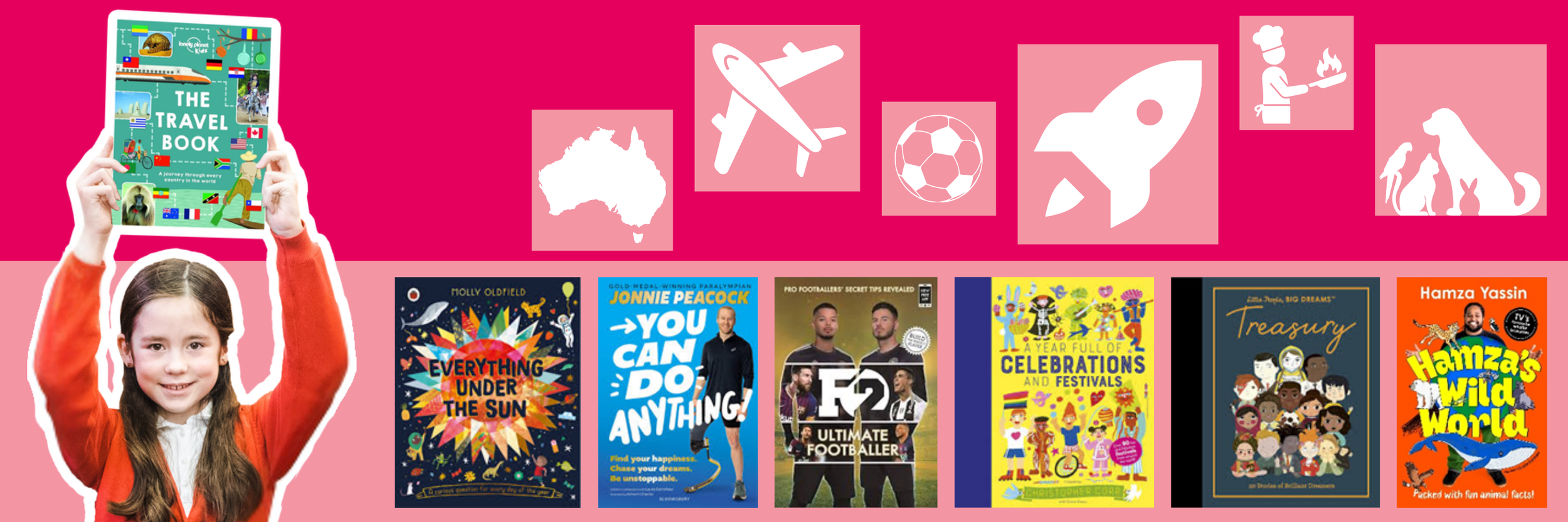
Ready Steady Read Together non-fiction vehicle texts include inspirational stories about real people in autobiography formats, such as Year 5 Coming to England by Floella Benjamin and Year 6 The Diary of a Young Girl by Anne Frank, as well as biography formats, including Year 2 Little People, Big Dreams Treasury, Year 4 42 Artists Everyone Should Know, Year 5 A Different Kind of Freedom: A Romani Story and Year 6 Women in Science.
How-to and instructional texts demonstrate a true purpose for reading, whether to develop a life skill through recipes, explore academic interests through science experiments or develop talents and hobbies such as art projects, Lego building or learning magic tricks.
We also ensured that texts align with children’s interests by incorporating fact and quiz books about animals, including Year 2 The Wild Life of Animals, Year 3 Hamza’s Wild World, Year 4 Quiz Yourself Clever: Animals of the World and Year 5 The Illustrated Encyclopaedia of ‘Ugly’ Animals, as well as sports texts such as Year 3 The Funny Life of Football, Year 4 F2 Ultimate Footballer and Year 5 Three Lionesses and Sport Legends.
Additionally, we selected self-help and motivational texts to inspire and support aspiration, including Year 6 Follow Your Dreams, Year 6 You Can Do It and Year 4 You Can Do Anything.
Extract Selection and Creating Emotional Investment
When selecting extracts for each fiction unit, our aim is to captivate the reader. Fiction extracts are chosen to create a sense of story arc, often featuring compelling scenes, emotional challenges or cliffhangers.
Our goal is for children to identify with characters and become so emotionally invested that, at the end of the unit, they are inspired to visit their local library or bookshop to discover what happens next. Beyond fostering a love of reading, we aim to cultivate empathy, understanding and acceptance in the next generation.
Curriculum Links Through Non-Fiction and Poetry
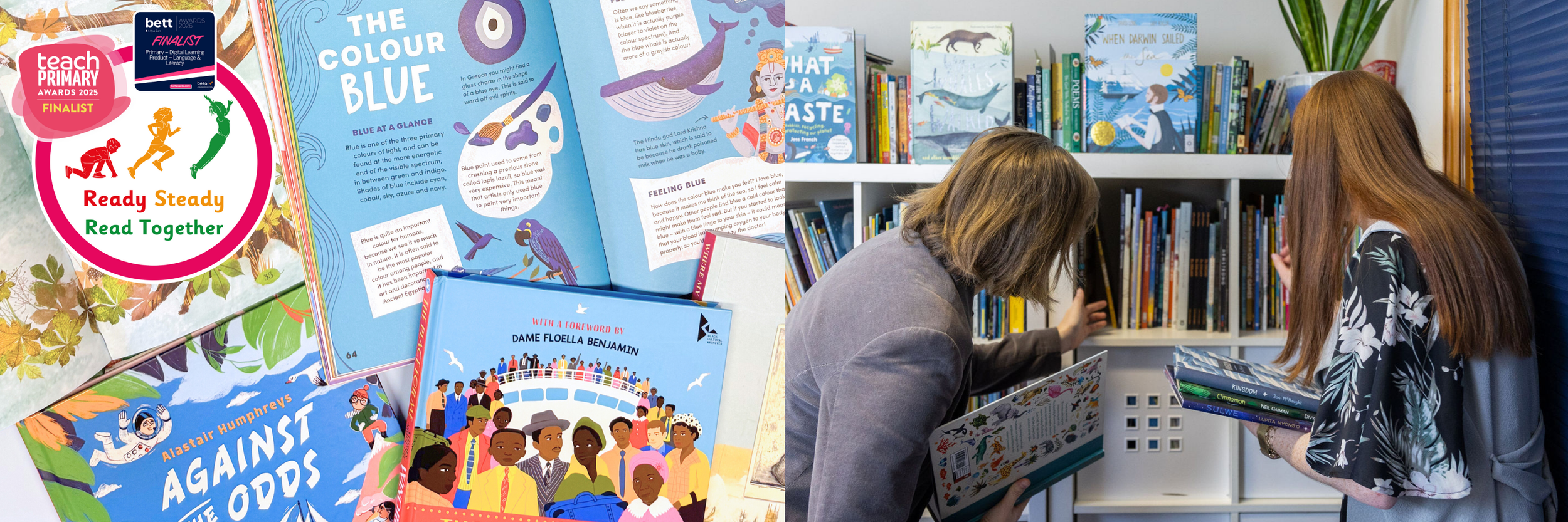
Extract selection in non-fiction and poetry units is guided by different principles. Some non-fiction and poetry texts offer valuable curriculum links. Below is a small sample of curriculum connections from our Year 2 units:
Poetry – First Book of Animals
Science: Children learn about animals and their habitats through poems about ants, dragonflies, chameleons and birds.Poetry – Poems for Every Season
Science: The poem Under the Ground explores how seeds and bulbs grow into mature plants across the seasons.Non-Fiction – Everything Under the Sun
Science: The extract Which Animal Makes the Best Mummy or Daddy? explores how adult animals care for their offspring.Non-Fiction – Very Important Things
Science: How Does it Grow? explains how seeds grow and what plants need to stay healthy.
History: Important Inventors explores inventions of national and global significance.
History: Celebrations and Festivals explores global commemorations.
History: Flying to the Moon details the moon landing and the lives of significant individuals.Non-Fiction – 101 Great Science Experiments
Science: Experiments such as Make a Plant Maze and Discover the Needs of Seeds explore plant growth, while Rain-Test Materials compares everyday materials for water resistance.Non-Fiction – Never Get Bored: Draw and Paint
Art: Lessons support children in using a range of materials and developing techniques in colour, pattern, texture, line, shape, form and space.Non-Fiction – Little People, Big Dreams Treasury
Art: Biographies such as Coco Chanel support learning about artists and designers.
Computing: Biographies of Ada Lovelace and Steve Jobs support understanding of the origins and uses of information technology.
As experienced educators, we possess extensive knowledge of the curriculum across all key stages. This enables us to carefully select extracts that align with the National Curriculum, supporting both teaching and learning. These lessons can act as effective pre-teaching, building conceptual understanding and topic-specific vocabulary ahead of curriculum teaching, while also providing opportunities to revisit and consolidate prior learning.
How Ready Steady Read Together Complements Ready Steady Write
Many Ready Steady Read Together vehicle texts were deliberately selected because of their direct links with Ready Steady Write units. Across the full programme, approximately 20% of Ready Steady Read Together vehicle texts connect to Ready Steady Write units. Within Key Stage 2, where themes broaden to include war, displacement and refugees, this alignment is even stronger. In Year 6, nearly 40% of Ready Steady Read Together vehicle texts link directly to Ready Steady Write units.
This intentional overlap allows children to explore subjects in real depth.
For example, in Ready Steady Write, Rose Blanche is a core unit. This powerful text recounts the events of the Second World War through the eyes of a young German girl who discovers a concentration camp hidden in the forest and secretly brings food to the imprisoned children. The narrative provides rich opportunities for discussion, empathy and nuanced writing.
Ready Steady Read Together deepens pupils’ understanding of this historical period through seven complementary units linked to the Second World War:
Autobiography: The Diary of a Young Girl by Anne Frank
Poetry Verse Novel: Digging for Victory by Cathy Faulkner
Poetry Anthology: Poems from the Second World War, compiled by Gaby Morgan
Historical Fiction: Safiyyah’s War by Hiba Noor Khan
Fiction: When the Sky Falls by Phil Earle
Poetry: On the Move by Michael Rosen
Multi-narrative Fiction: Refugee by Alan Gratz
Strengthening Writing Through Connected Reading
When reading comprehension texts are closely aligned with writing content, pupils encounter a rich bank of topic-specific vocabulary, contextual detail and background knowledge. This strengthens subject understanding and provides a solid foundation for high-quality writing.
Through reading, children absorb precise language, powerful imagery and authentic viewpoints which they can later draw upon in their own writing. Exploring themes through a range of genres, including narrative, non-fiction, poetry and eyewitness accounts, exposes pupils to different ways ideas can be communicated.
They see how writers structure arguments, build tension, convey emotion and present information. This breadth of exposure deepens comprehension and models the craft of writing in meaningful contexts.
By immersing children in connected reading and writing experiences, they form informed opinions and interpretations of complex themes and historical periods. Their writing becomes more confident, more coherent and richer because it is grounded in knowledge.
Find Out More
If you are searching for Steps to Read or Ready Steady Comprehension, we invite you to explore the next generation of shared reading:
Ready Steady Read Together is already helping hundreds of schools raise reading standards and build confident, motivated readers. Discover why so many teachers are choosing it as their shared reading solution today.